


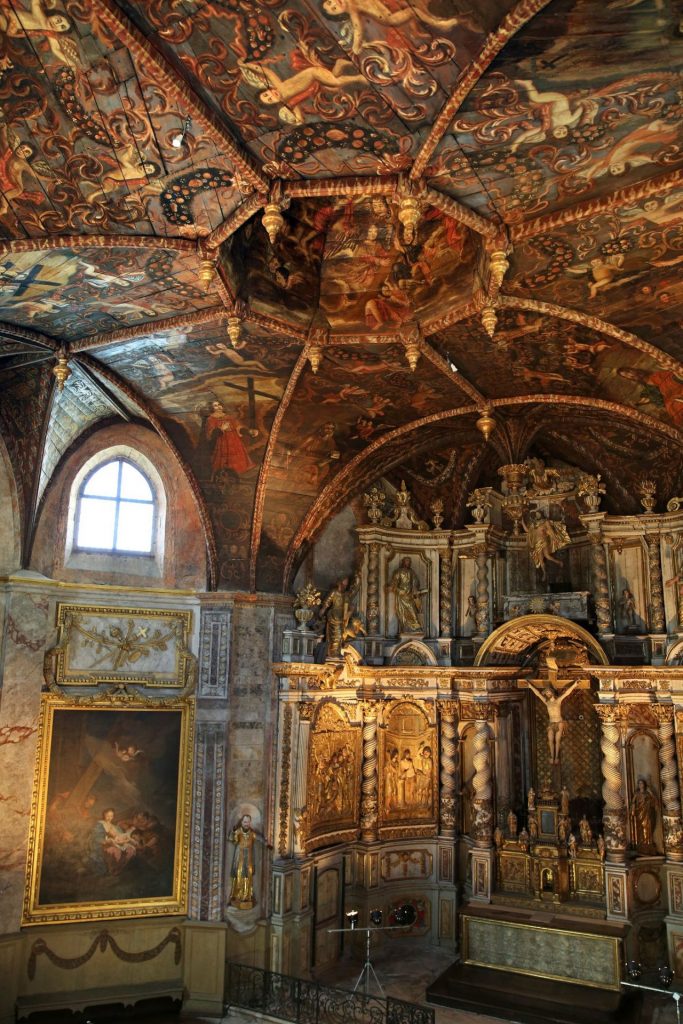
This chapel with a slate roof seems very discreet. The clothes do not make the man ! Push open the doors of the Chapel of the Black Penitents to discover a true masterpiece of Baroque art: entirely painted vault and sculpted and gilded altarpiece.
Flanked by a relatively sober facade and topped with an elegant double-clocheton covered with lauzes, the chapel of the Black Penitents houses an exceptional interior decor. This masterpiece of the XNUMXth and XNUMXth centuries has a wooden vault painted in bright colors, an imposing gilded altarpiece and six large paintings framed with plasterwork.
Follow Géraud Caval, former member of the brotherhood, and let him tell you about the riches of the chapel of the Pénitents Noirs in Villefranche-de-Rouergue
A fascinating story
In the aftermath of the Wars of Religion, the Catholic Church tried to reaffirm its place by encouraging the creation of Brotherhoods of Penitents. In 1609, two of them were born in Villefranche-de-Rouergue : the Blues, on the banks of the Aveyron river, and the Blacks, on the upper part of the bastide.
The Penitents were essentially lay people, men and women, anxious to redeem their faults by helping those who were in need: poor, sick, condemned to death, prostitutes... On Good Friday, they strolled through the streets of the city, carrying a black robe and hood and waving banners to the glory of certain saints. They then took the Stations of the Cross leading to the top of the hill of Saint-Jean d'Aigremont, where a chapel erected in the XNUMXth century commemorates this tradition.
Undermined at the time of the French Revolution, the brotherhood resumed its activity in 1805 until 1905, date of the law of Separation of Church and State. The processions lasted until the beginning of the 2010s and the project of a recovery is now being considered.
An exceptional decor
To be part of the brotherhood, Penitents had to pay an annual fee and make donations at auction. The money raised allowed the purchase of several plots of land on which the chapel was built, on the model of the Holy Sepulcher of Jerusalem.
In 1701, a Villefranche workshop produced the exceptional wooden arch painted on which figures cherubs undulating in vegetal arabesques, ribbons and garlands of fruits and flowers, Holy Cross, emblem of the brotherhood, Constantin I, King Louis XIV, Saint Helena, Saint Francis de Sales and the four evangelists.
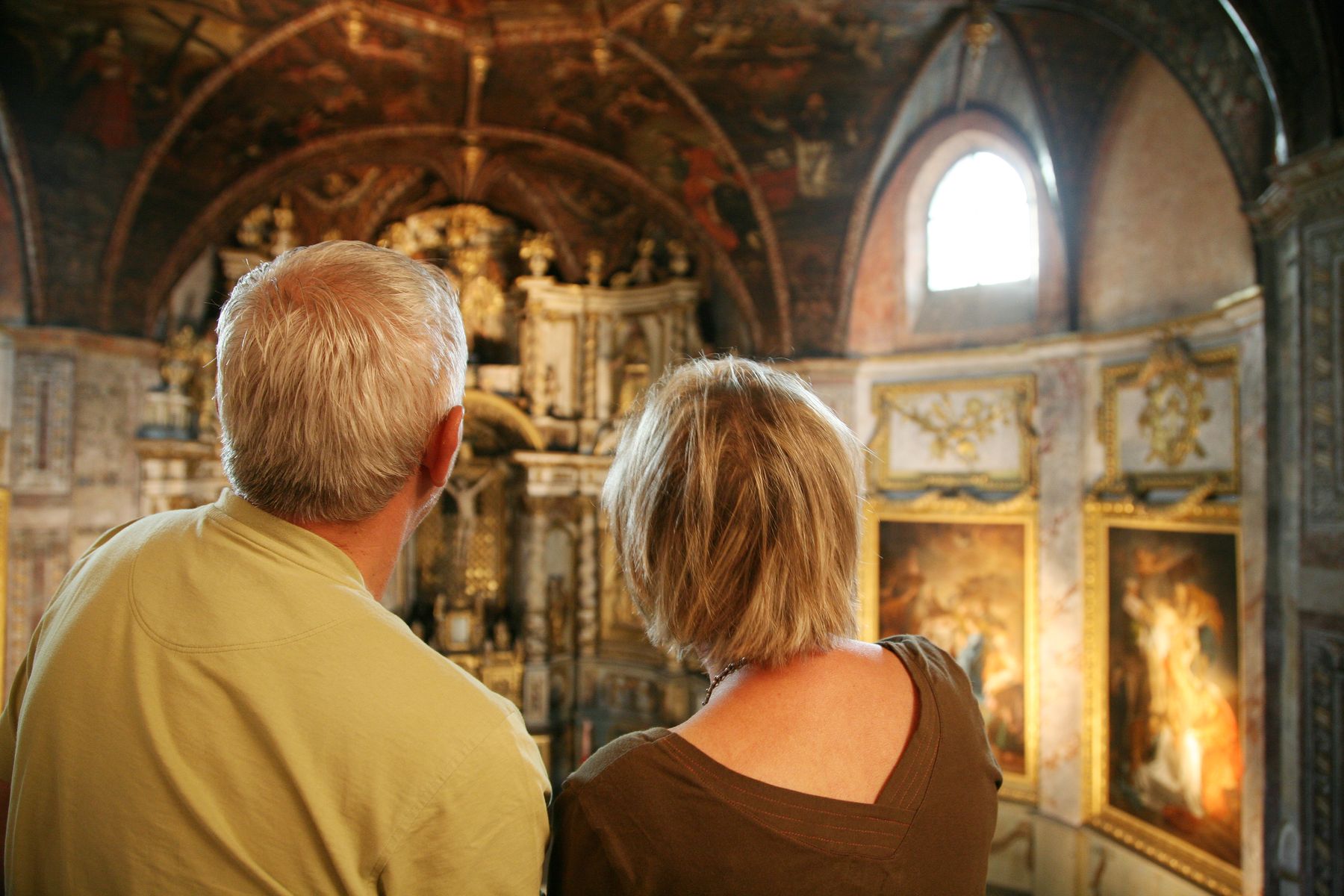
In 1709, the brotherhood commanded the immense altarpiece which flanks the choir of the chapel. On the latter, there are four panels showing the last moments of the Passion of Christ. In the center, we find the Crucifixion with the Resurrection of Christ joining God and the dove of the Holy Spirit.
In 1764, six large paintings representing the Annunciation, the Marriage of Joseph and Mary, the Crucifixion, the Deposition, the Presentation in the Temple and the Nativity were commissioned from Toulouse artist Charles Dujon. These were inserted into plasterwork frames surmounted by liturgical objects and musical instruments.
Visit the Chapel of the Black Penitents
The Chapel of the Penitents is a must on your visit to Villefranche de Rouergue. Immerse yourself in this surprising place in the heart of the historic center.
For the visit, several solutions are available to you:
- Visit with an explanatory leaflet on a background of baroque music
- Listen to the audio guide
- Follow a tour guide
- Take a torchlight night tour
- Solve the puzzles of a small children's game
In order to view the different information, you can use the navigation arrows placed to the right of the table
| Prices | Min. | Max. |
|---|---|---|
| Individual adult free visit |
4 € | 5 € |
| Individual child free visit |
4 € | - |
| Individual adult guided tour – Classic guided tour |
5.5 € | 7 € |
| Individual child guided tour – Classic guided tour |
5.5 € | - |
| Individual adult guided tour – Night guided tour |
5.5 € | 9.5 € |
| Individual child guided tour – Night guided tour |
5.5 € | - |
| Individual adult guided tour – Sensory guided tour |
7 € | - |
Chapel of the Black Penitents
12200 Villefranche-de-Rouergue


